


You already know you need a capable vehicle. What most people do not know is that their vehicle’s advertised towing capacity is often the least important number in the equation.
Buying a boat is the easy part. Getting it home, legally and safely, requires understanding four overlapping weight limits that most sellers will never explain to you. Exceed any one of them, and you are driving an unregistered combination, voiding your insurance, and gambling with your brakes.
Australia has close to 900,000 registered boats and more than 2.5 million licensed powerboat operators, according to the Boating Industry Association’s Data Report Card. A huge portion of those boats travel on trailers towed by vehicles whose owners have no idea whether their setup is legal.
This article gives you the exact framework to calculate what you need, matched to the type of boat you plan to tow.
Table of Contents
- Why Towing Capacity Is the Wrong Starting Question
- The Four Numbers That Actually Govern Legal Towing in Australia
- How Much Does a Boat and Trailer Actually Weigh?
- Boat Type vs. Minimum Towing Capacity: Comparison Table
- The 10% Towball Rule and Why It Matters
- The Braking Threshold You Cannot Ignore
- How to Match a Tow Vehicle to Your Boat
- Interstate Boat Transport: What Changes on a Long Haul
- Common Mistakes That Put You at Legal and Physical Risk
- Conclusion
Why Towing Capacity Is the Wrong Starting Question
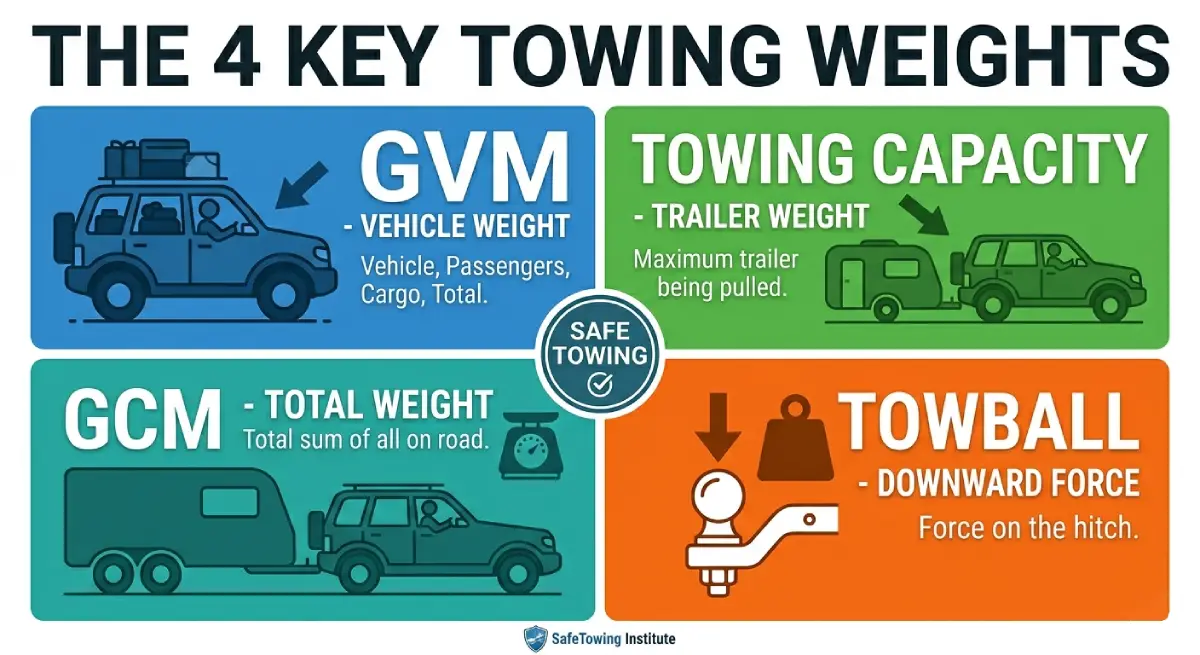
When someone asks, “What towing capacity do I need?”, they are treating one variable as if it explains everything. It does not. A vehicle rated to tow 3,500 kg can still be illegal to tow a 2,000 kg boat if the vehicle is already loaded to its Gross Vehicle Mass (GVM) limit.
The advertised brake towing capacity is a ceiling. Your actual, legal towing capacity on any given day is lower, calculated from what is already in and on your vehicle.
Start with the boat’s weight. Then work backwards to the vehicle.
The Four Numbers That Actually Govern Legal Towing in Australia
1. Braked Towing Capacity
This is the maximum Aggregate Trailer Mass (ATM) your vehicle can legally pull when the trailer has its own brakes. This is the number car manufacturers and dealers advertise. It is the starting point, not the finish line.
2. GVM (Gross Vehicle Mass)
The maximum your loaded vehicle can weigh. That includes fuel, passengers, accessories, a bullbar, a roof rack, camping gear, and the towball download from your trailer. Exceed your GVM, and you are in breach of road rules regardless of your towing capacity.
3. GCM (Gross Combination Mass)
The maximum total weight of your tow vehicle plus the trailer, fully loaded. The formula is simple:
Maximum legal trailer ATM = GCM minus actual loaded GVM
A vehicle with a 3,500 kg GVM and a 5,800 kg GCM can only tow 2,300 kg of trailer if it is loaded to GVM. Most people do not run this calculation.
4. Towball Download (TBD)
The downward force the trailer exerts on your towball. This counts against your vehicle’s GVM and payload. Ignore it, and you can tip both calculations at once.
How Much Does a Boat and Trailer Actually Weigh?
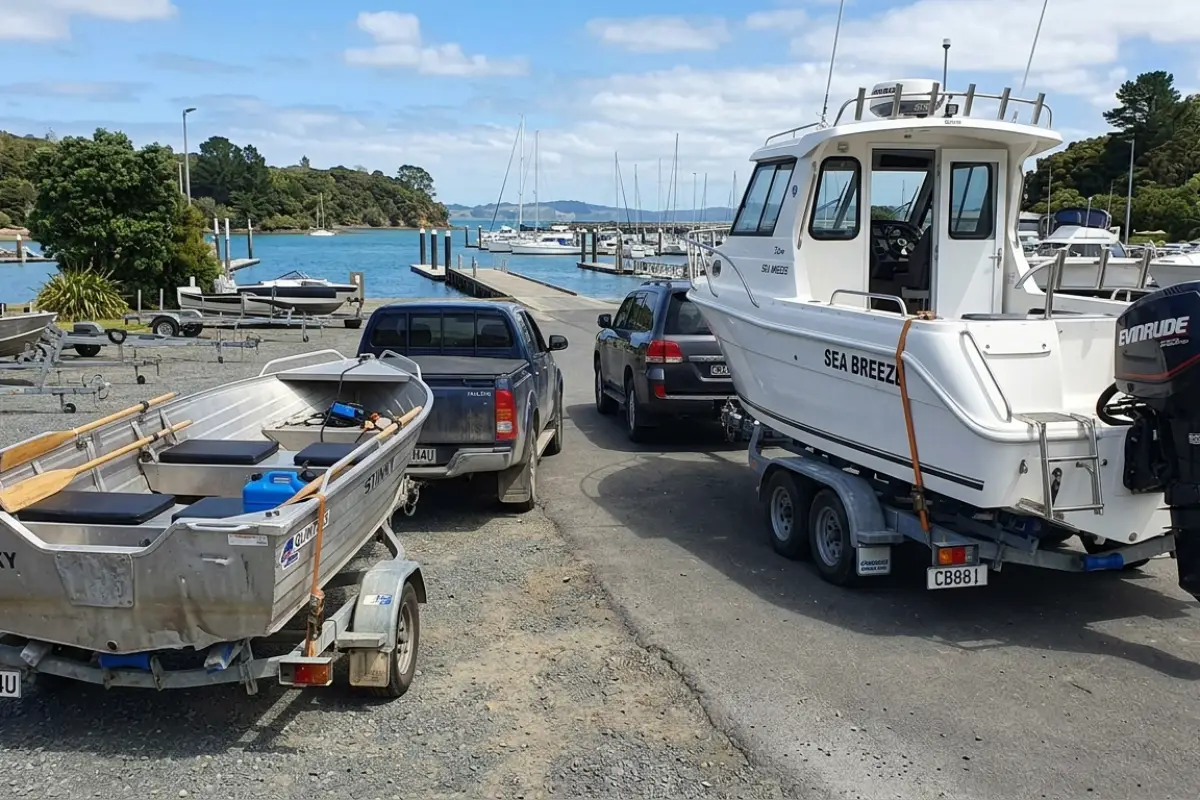
This is where most buyers get it wrong. They look at a 5-metre fibreglass runabout and estimate it “can’t weigh much.” Then they add a 40hp outboard, a full fuel tank, safety gear, an anchor, rods, and a trailer, and the number is double what they expected.
The ATM (Aggregate Trailer Mass) is the number you need. It is the total maximum weight of the trailer plus the boat plus everything on it, including fuel and gear.
General weight-building formula for a boat setup:
- Hull weight (dry, no motor)
- Plus outboard or I/O motor weight
- Plus fuel (petrol weighs approximately 0.74 kg per litre)
- Plus safety, fishing, or sports gear
- Plus trailer tare weight
The ATM is stamped on your trailer’s compliance plate. Never tow over it.
Boat Type vs. Minimum Towing Capacity: Comparison Table
The figures below represent typical fully-loaded ATMs for common Australian boat configurations. Your actual boat may vary. Always check the trailer compliance plate and add your expected payload.
| Boat Type | Typical Boat + Motor (kg) | Typical Trailer (kg) | Estimated ATM (kg) | Min. Braked Tow Capacity Recommended |
| Small aluminium tinnie (3.5-4.5m) | 150-350 | 150-200 | 300-550 | 750 kg (may be unbraked) |
| Fibreglass runabout (4.5-5.5m) | 400-700 | 200-300 | 600-1,000 | 1,200 kg braked |
| Ski boat / bowrider (5-6m) | 700-1,200 | 250-400 | 950-1,600 | 2,000 kg braked |
| Centre console / fishing (5.5-6.5m) | 800-1,400 | 300-450 | 1,100-1,850 | 2,200 kg braked |
| Cabin cruiser (6-7m) | 1,200-2,000 | 400-600 | 1,600-2,600 | 3,000 kg braked |
| Pontoon boat (5.5-7m) | 900-1,500 | 450-600 | 1,350-2,100 | 2,500 kg braked |
Note: Always add 10-15% buffer above your calculated ATM when selecting a tow vehicle. Towing at 100% of rated capacity is legal; it is not safe.
The 10% Towball Rule and Why It Matters
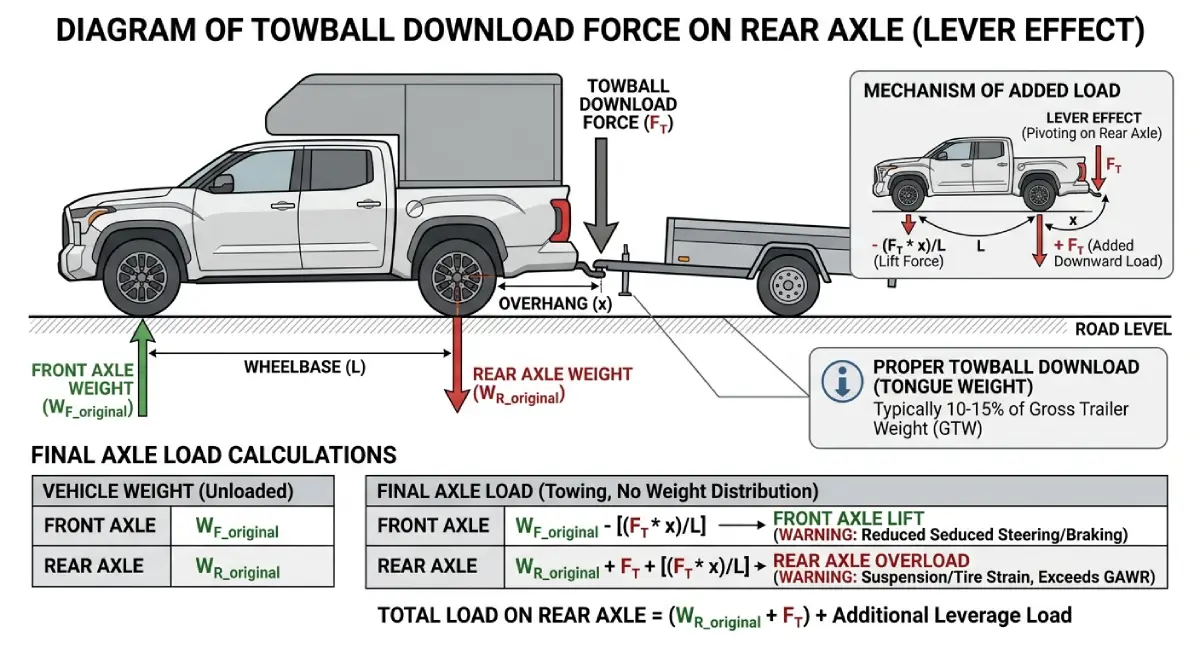
The towball download (TBD) is approximately 10% of your trailer’s ATM. For a 1,500 kg boat setup, that is 150 kg pressing down on your tow ball, directly subtracted from your vehicle’s remaining payload.
A correctly loaded boat trailer should sit between 8-12% TBD. Below 8%, and the trailer becomes unstable at speed. Above 12%, and your rear axle is overloaded, your steering goes light, and your tow vehicle’s GVM takes a serious hit.
If your boat is consistently tail-heavy with motors and fuel at the stern, check where your trailer bunks are positioned. Redistributing load forward by 10-15% of boat length is often enough to bring TBD into range.
The Braking Threshold You Cannot Ignore
Australian law is unambiguous on this point: any trailer with an ATM exceeding 750 kg must have its own independent braking system. This is not optional, and it is not negotiable.
An unbraked boat trailer at 750 kg adds approximately 20-30 metres to your stopping distance in an emergency stop at 100 km/h. For a 1,200 kg unbraked load, that number becomes genuinely dangerous.
If you are buying a second-hand boat, check the trailer compliance plate. Verify the trailer has an operational brake actuator, working brake shoes or discs, and that the system has been recently inspected. A boat trailer used in salt water needs its brakes flushed and inspected far more frequently than most owners do.
How to Match a Tow Vehicle to Your Boat
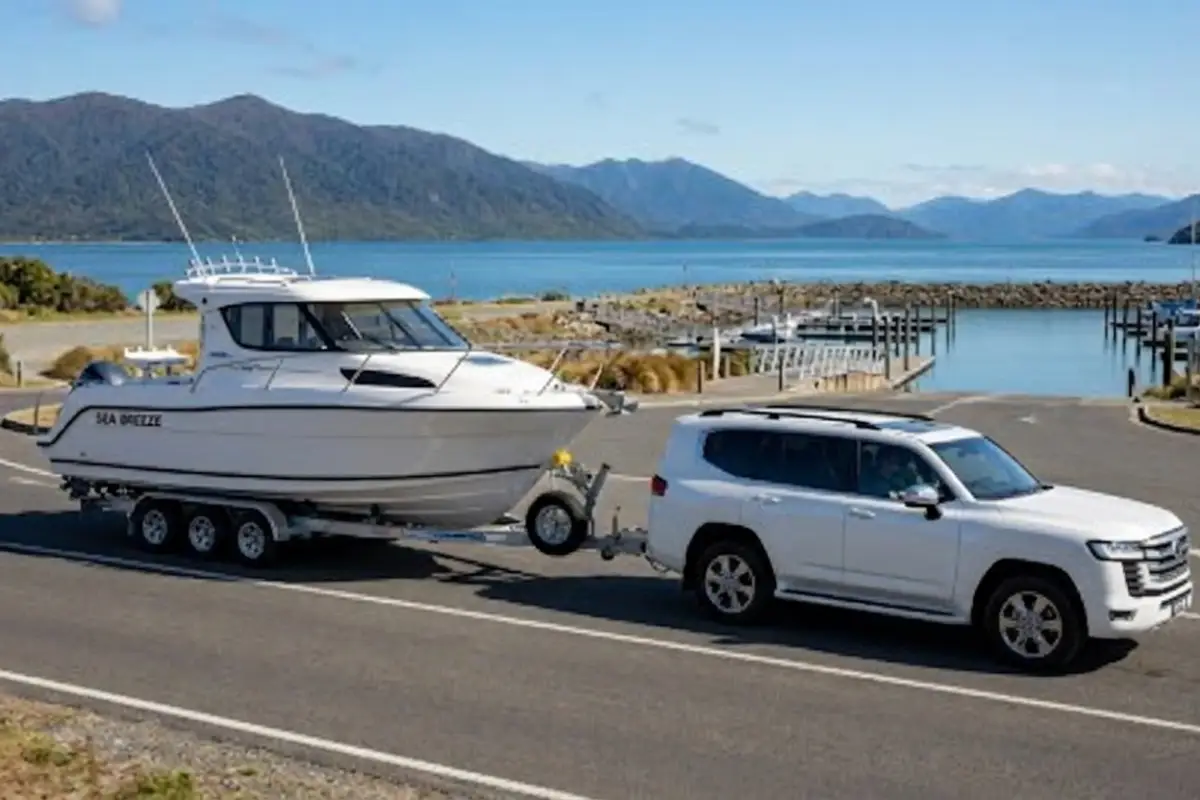
Work through this checklist in order. Do not skip steps.
Step 1: Get the ATM from your trailer’s compliance plate
That is your hardest number. Do not estimate.
Step 2: Check your vehicle’s braked towing capacity
It must exceed the ATM. Find it in your owner’s manual or on your vehicle’s compliance plate, not from a manufacturer’s website, as it varies by build specification.
Step 3: Calculate your available GCM margin
Load your tow vehicle as you would on the day: full fuel, passengers, and gear. Weigh it at a public weighbridge if you are close to limits. Subtract that from your GCM. The remainder is your actual available tow capacity. If that number is less than your trailer’s ATM, you cannot legally tow that day.
Step 4: Calculate your available payload minus towball download
Take the towball download (10% of ATM) and subtract it from your vehicle’s remaining payload. If your payload is already eaten up by passengers and gear, you may be over GVM before the trailer even moves.
Step 5: Confirm your towbar rating
Your towbar has its own rated capacity and maximum ball download. It must match or exceed your trailer’s requirements. Aftermarket towbars require engineering certification and must be rated appropriately.
Before any tow, check that your tyres are inflated to the recommended tyre pressure for a loaded vehicle, since most manufacturers specify a higher cold inflation figure when operating near GVM.
Interstate Boat Transport: What Changes on a Long Haul
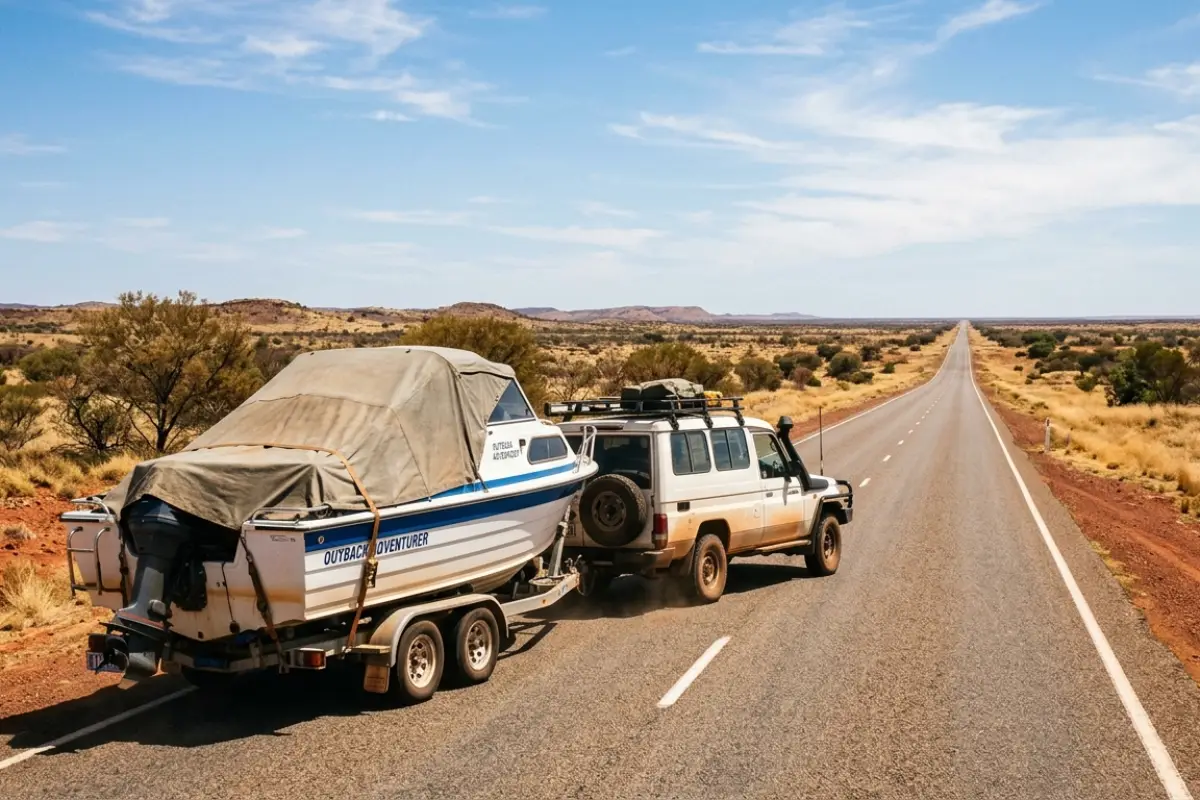
Interstate Boat Transport across a state border introduces variables that a local ramp run does not. Your combination must comply with the road rules of every state you pass through, not just your home state. While trailer registration from your home state is recognised nationally under the Australian Road Rules framework, the standards your vehicle and trailer must meet at the point of inspection are those of the state you are travelling in.
Oversize loads are the first issue. Most recreational boats under 2.5 metres wide travel without any permit requirement. If your beam exceeds 2.5 metres, you enter oversize load territory in most states, which means permits, travel-time restrictions (typically daylight only), and in some cases a pilot vehicle. Confirm with the road authority of each state you are transiting before you leave.
Trailer brake systems take far more stress on a long haul. A local 20-minute ramp run does not stress a brake actuator the way a 1,000 km drive across Queensland does. Before any interstate tow, inspect brake fluid levels, check for dragging or uneven wear, and if your trailer uses disc brakes in saltwater service, flush them. Overheated or seized brakes on a long descent are not a roadside fix.
Fuel and payload planning changes. Towing a heavy boat setup at highway speeds increases fuel consumption by 30-50%, depending on wind exposure and gradient. Plan your fuel stops around load, not just distance, and account for the additional weight of jerry cans if you are heading into remote areas with long gaps between fuel stops.
Fatigue laws apply to the tow vehicle driver. Interstate drives with a boat in tow are physically more demanding than unloaded highway driving. The constant correction, wind buffeting, and concentration required on a heavy combination count under general fatigue management obligations. If you are travelling more than 500 km, factor in rest stops regardless of how confident you feel.
Common Mistakes That Put You at Legal and Physical Risk
Trusting the advertised towing capacity as a real-world number. Manufacturers quote the braked towing capacity at the kerb weight. The moment you add fuel, passengers, and accessories, your real-world capacity shrinks.
Buying a trailer with no brakes for a boat over 750 kg. This happens constantly in the second-hand market. The seller does not mention it. The buyer assumes compliance. Check the plate, then check the actual brakes.
Ignoring boat-ramp physics. A vehicle that legally tows a boat on a flat road may not have the low-range torque or the rear-axle traction to retrieve a heavy boat from a steep, wet concrete ramp. This is where front-wheel drive and low-capacity vehicles fail in real life.
Not accounting for gear and fuel post-purchase. A 1,200 kg ATM trailer with a “light” fishing boat still needs a full fuel tank (40 litres = 30 kg), rods, safety gear, an anchor, a battery, and whatever you threw in the hull before leaving home. That number climbs fast.
Assuming last year’s tow vehicle still fits this year’s boat upgrade. When you move from a 4.5m tinnie to a 6m fibreglass half-cabin, your ATM may double. Run the numbers again from scratch.
Conclusion
Your vehicle’s advertised towing capacity is a ceiling, not a guarantee: the real limit on any given day is set by GVM, GCM, towball download, and what you are already carrying. Match your tow vehicle to your boat’s ATM first, run the four-number check before every trip, and never assume a setup that worked once is compliant every time.


